

For Briana Jones, a young Black mother in San Francisco, a city program called the Abundant Birth Project has been a godsend.
Designed to counter the “obstetric racism” that researchers say leads a disproportionate number of African American mothers to die from childbirth, the project has provided 150 pregnant Black and Pacific Islander San Franciscans a $1,000 monthly stipend.
The money enabled Jones, 20, to pay for gas to drive to prenatal clinics, buy fresh fruits and vegetables for her toddler son and herself, and remain healthy as she prepared for the birth of her second child last year.
But the future of the Abundant Birth Project is clouded by a lawsuit alleging that the program, the first of its kind in the nation, illegally discriminates by giving the stipend only to people of a specific race. The lawsuit also targets San Francisco guaranteed-income programs serving artists, transgender people, and Black young adults.
The litigation is part of a growing national effort by conservative groups to eliminate racial preferences in a wide range of institutions following a U.S. Supreme Court ruling that found race-conscious admissions to colleges and universities to be unconstitutional.
In health care, legal actions threaten efforts to provide scholarships to minority medical school students and other initiatives to create a physician workforce that looks more like the nation.
The lawsuits also endanger other measures designed to reduce well-documented racial disparities. Black women are three to four times more likely than white women to die in labor or from related complications in the U.S., and Black infants are twice as likely as white infants to be born prematurely and to die before their first birthdays. Racial and ethnic minorities also are more likely to die from diabetes, high blood pressure, asthma, and heart disease than their white counterparts, according to the Centers for Disease Control and Prevention.
A handful of activist nonprofit groups and law firms are leading the charge. Do No Harm, a nonprofit formed in 2022, has sued health commissions, pharmaceutical companies, and public health journals to try to stop them from choosing applicants based on race. Do No Harm claims more than 6,000 members worldwide and partners with nonprofit legal organizations, most notably the Pacific Legal Foundation, which garnered national attention when it defended California’s same-sex marriage ban.
Another nonprofit, the Californians for Equal Rights Foundation, together with a Dallas-based law firm called the American Civil Rights Project, filed the lawsuit against the city of San Francisco and the state of California over the Abundant Birth Project, alleging the program violates the equal protection clause of the Constitution’s 14th Amendment by granting money exclusively to Black and Pacific Islander women. The 14th Amendment was passed after the Civil War to give rights to formerly enslaved Black people.
The lawsuit calls public money used for the project and the three other guaranteed-income programs “discriminatory giveaways” that are “illegal, wasteful, and injurious.”
“The city and county of San Francisco crafted the Abundant Birth Project with the express intention of picking beneficiaries based on race,” Dan Morenoff, executive director of the American Civil Rights Project, said in a phone interview. “It’s unconstitutional. They can’t legally do it, and we are optimistic that the courts will not allow them to continue to do it.”
San Francisco and state officials declined to discuss the case because of the pending litigation, but the city defended the program in its initial response to the lawsuit. The Abundant Birth Project started in June 2021 and plans to make a second round of grants to pregnant mothers this fall, the response says.
The project strives to improve maternal and infant health outcomes by easing the economic stress on pregnant Black and Pacific Islander San Franciscans. People in those groups face some of the worst outcomes in the U.S., where more women die as a result of pregnancy and childbirth than in other high-income nations. The state of California last year awarded $5 million to expand the program to include Black mothers in four other counties.
But Khiara Bridges, a Berkeley law professor and anthropologist who has talked to beneficiaries of the Abundant Birth Project but is not directly involved with it, said the Supreme Court ruling on college affirmative action could actually support the argument that the program is legal.
The court struck down affirmative action in part because the majority said Harvard and the University of North Carolina failed to show measurable outcomes justifying race consciousness in college admissions. While statistics on potential benefits from the Abundant Birth Project are not publicly available, Bridges and others familiar with the program expect researchers to demonstrate it saves and improves lives by comparing the health outcomes of families who received the stipend with those of families who did not. The outcomes could justify employing race to choose program participants, Bridges said.
Bridges also drew another distinction between the role of race in college admissions and the role of race in health disparities.
“If you don’t get into Harvard, there’s always Princeton or Columbia or Cornell,” she said. “Maternal death — the stakes are a little bit higher.”
In California, a voter initiative, Proposition 209, has prohibited race-based selection in public education and employment since 1996. California Assembly member Mia Bonta (D-Oakland) has co-authored a pending bill that would amend the proposition to allow municipalities to grant benefits to specific groups of vulnerable people if they use research-based measures that can reduce health and other disparities.
Bonta, a law school graduate, told KFF Health News that the litigation against the Abundant Birth Project is the result of “conservative groups who want to exist in a world that doesn’t exist, where communities of color have not had to suffer the generational harm that comes from structural racism.”
Bonta has more than once been a victim of medical racism herself.
When she went to the hospital with a serious back injury, she was interrogated by a doctor who appeared to believe she was faking pain so she could obtain drugs.
“But for the intervention of my husband, who happened to be there and moved into health advocacy mode, I, as a Black Latina woman, would not have received the care that I needed,” she said. Bonta’s husband, Rob Bonta, is also a lawyer and is now California’s attorney general.
Briana Jones experiences racism every day, she said.
She was 15 when she gave birth to her first child in a San Francisco hospital. Terrified and in agonizing pain, she did what laboring mothers have always done and screamed.
A nurse ordered her to “shut up.”
In the U.S., Black women are far more likely than white women to report that health care providers scolded, threatened, or shouted at them during childbirth, research shows. They also face other forms of obstetric racism, including barriers to quality care and cumulative stress from lifelong discrimination.
Growing up Black in predominantly white and Asian San Francisco has been a struggle for Jones. But, while carrying her second baby last year, she learned from her mother of the Abundant Birth Project, and within a month, her race and address in Bayview Hunters Point, where some of the city’s poorest residents live, qualified her as one of nearly 150 women to receive the $1,000 a month during her pregnancy and for six months postpartum.
“I really did feel like it was God helping me,” she said.
For Morenoff, though, it’s just another form of discrimination, and he says the city must either open the Abundant Birth Project to all pregnant women or close it down. “The whole point of the 14th Amendment is to require America to treat all Americans as Americans with the same equal rights,” he said.
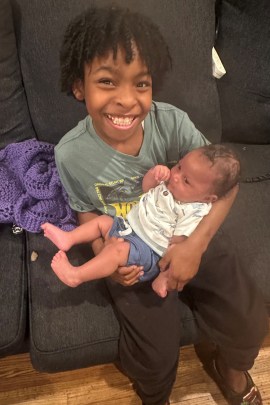
Jones had high blood pressure, leading to swollen ankles and dizziness, during both her pregnancies. In her more recent one, the birth project stipend helped enable her to quit couch surfing and move into an apartment, and she gave birth to a healthy boy named Adonis.
“It’s known that people of color struggle way harder than other races,” Jones said. “Where I live, it’s nothing but struggle here, people trying to make ends meet.”
“For them to try to take this program away from us,” she said, “it’s wrong.”
This article was produced by KFF Health News, which publishes California Healthline, an editorially independent service of the California Health Care Foundation.