

While Pandey, whose household income can be up to ₹15 lakh per year, is among the top earners in the country, the trend of paying a premium for better education through private schools, colleges and coaching is quite common in India, especially in urban areas.
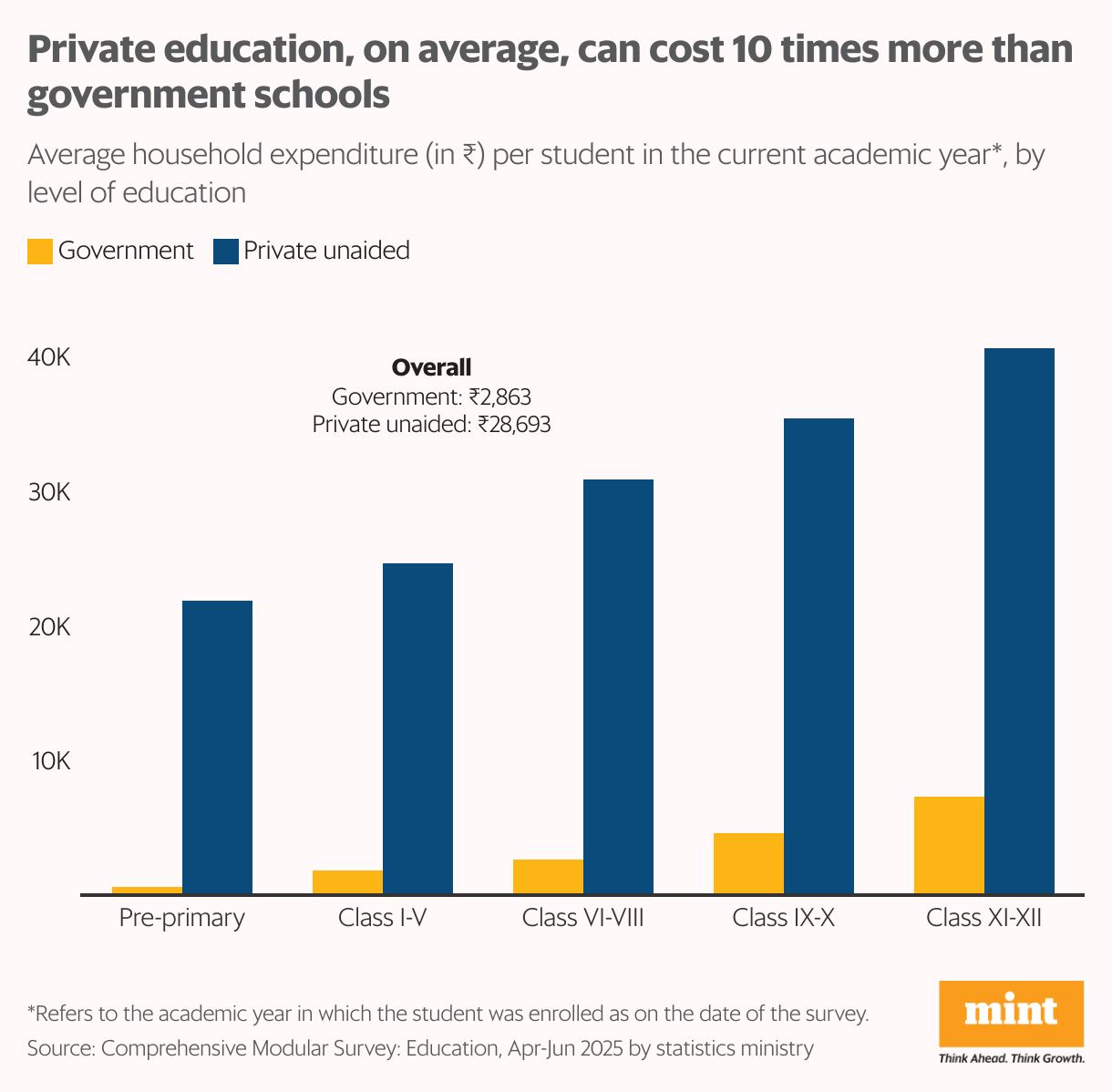
The results of a new survey, The Comprehensive Modular Survey: Education (April-June 2025), released late last month, shed light on these trends in India. The data, which covered 221,617 persons in 52,085 households, showed that 51% students were enrolled in private (unaided) schools, even as the average household expenditure on them can be 10 times more than that in government schools.
This not only represents the struggles of the public education system, marred by insufficient funding, poor infrastructure and a shortage of well-qualified teachers, but also an unequal system where those with lower income are often left behind. Case in point: in rural areas, where income levels are lower, nearly two-thirds of students are enrolled in government schools, nearly three times more than the level seen in urban areas.
Paying premium
For decades, private education has offered a way to escape the struggling government system for those who can afford to spend more money on better learning. Data shows that private education can be an expensive affair compared to government education, especially at pre-primary, primary and middle levels.
A Mint analysis of the data shows that the household average spending on private (unaided) schools at the pre-primary level can be as much as 35 times that of government schools. The gap is lowest at the higher secondary level (class XI-XII), but private education can still cost 5.6 times more than government schools. The yawning gap assumes more importance as enrollment in private schools has seen a steady rise in recent years, with the education ministry in May asking states to take measures to reverse the trend, media reports said.
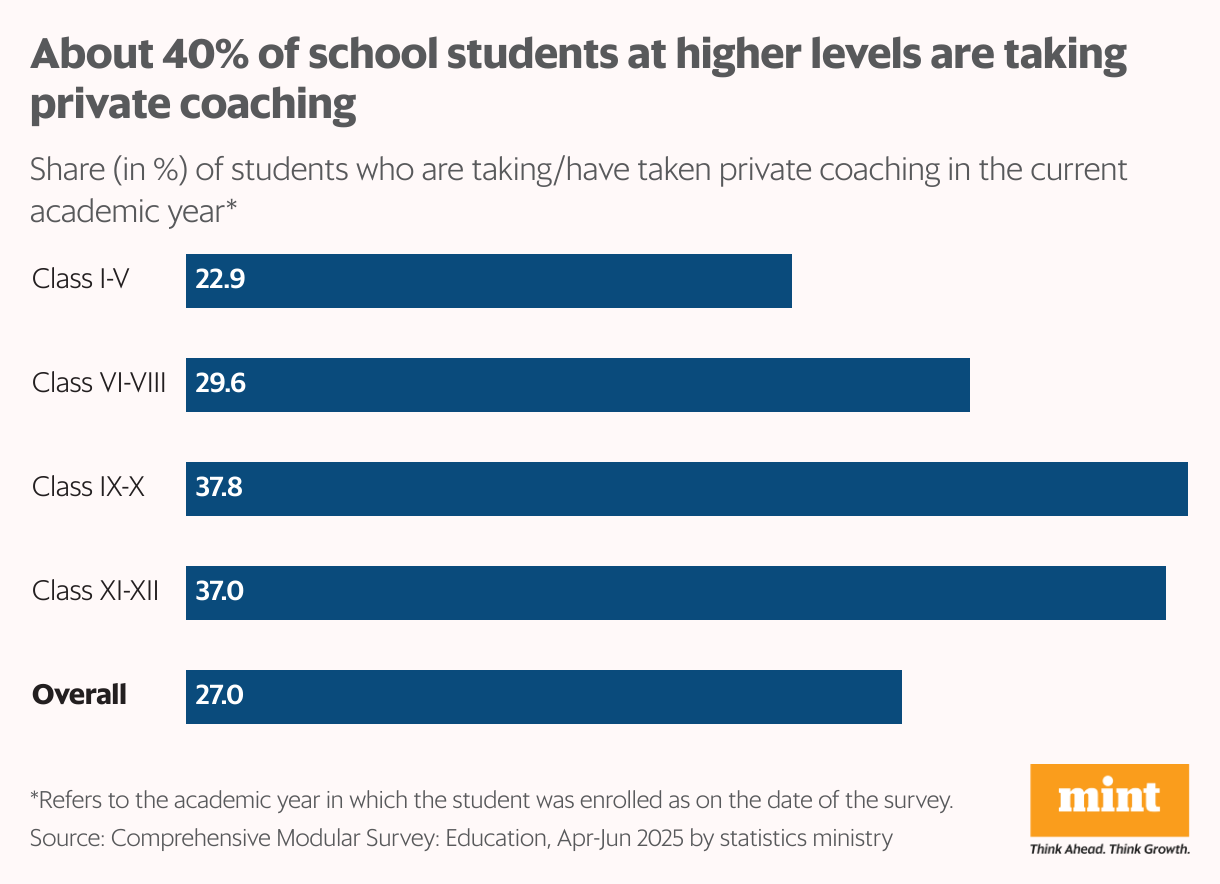
Besides private school education, private tuitions— or shadow schooling—have also become an important part of the process for a large number of Indians. In rural areas, 25.5% of students are taking, or have taken, private coaching, while in urban areas, the figure is slightly higher at 30.7%. The prevalence of private coaching is particularly higher at secondary and higher secondary levels in urban areas, at about 40-45%.
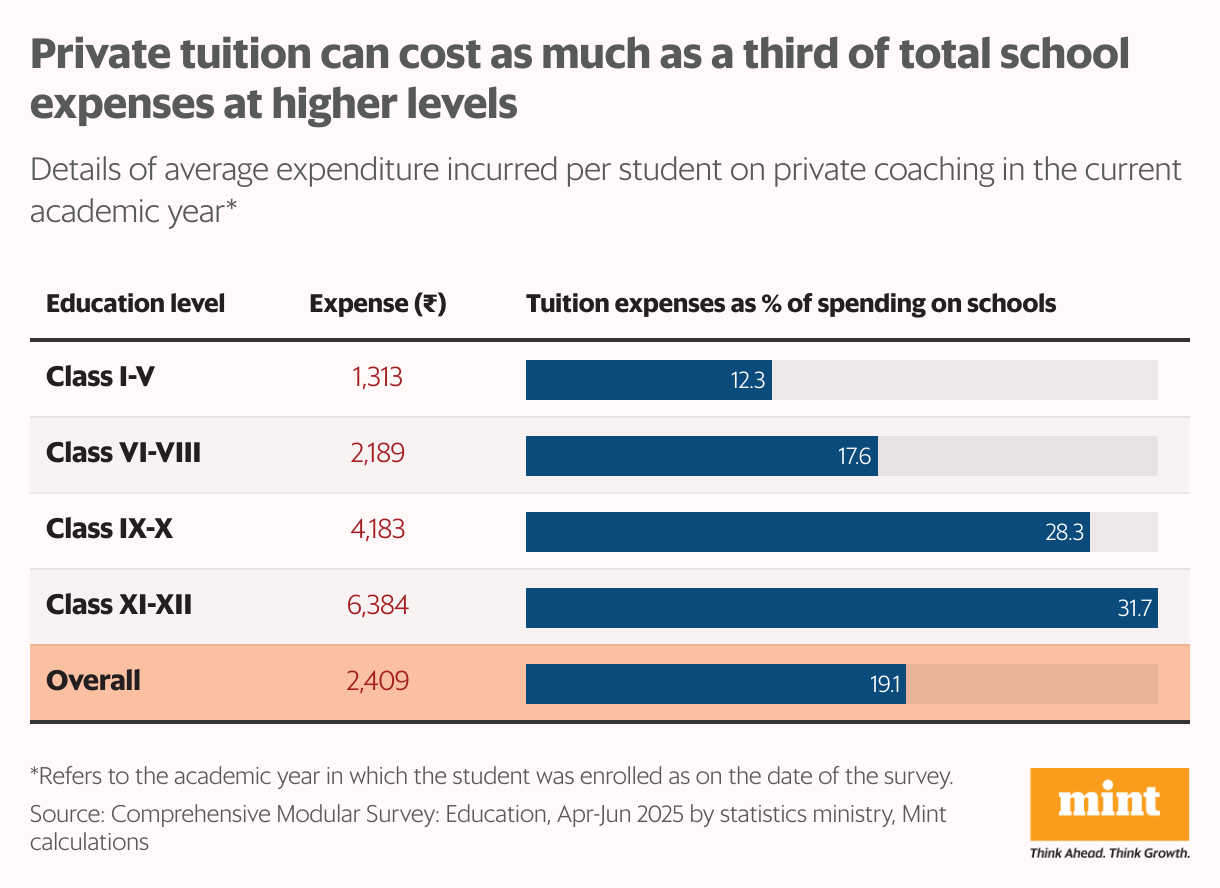
The need for private coaching comes at an additional cost. A Mint analysis of data shows that private coaching costs, on average per student, can be one-fifth of the total expenditure on school education. This can rise to 31.7% at higher secondary levels. As such, if the average cost of school education per student was ₹20,133, private coaching was ₹6,384.
Return on investments?
Despite the rising cost of education in the country, especially in the private sector, the path becomes tougher after schooling. With only a handful of prestigious government-funded universities and colleges, students face cut-throat competition at the undergraduate and postgraduate levels, making private education an alternative at the college level, too.
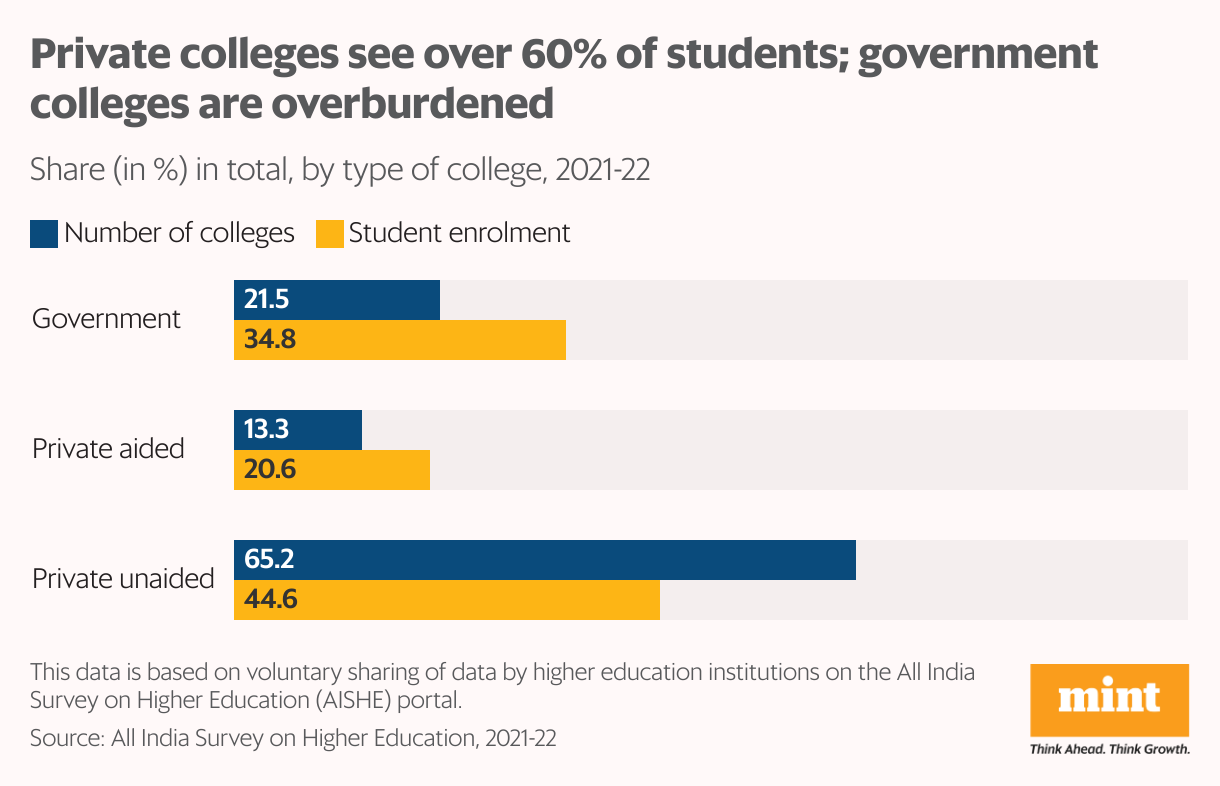
Data from the All India Survey of Higher Education shows that nearly two-thirds of students are enrolled in private (aided and unaided) colleges. Moreover, the government colleges may be overburdened as they account for 21.5% of total colleges in India, but see nearly 35% student enrollment.
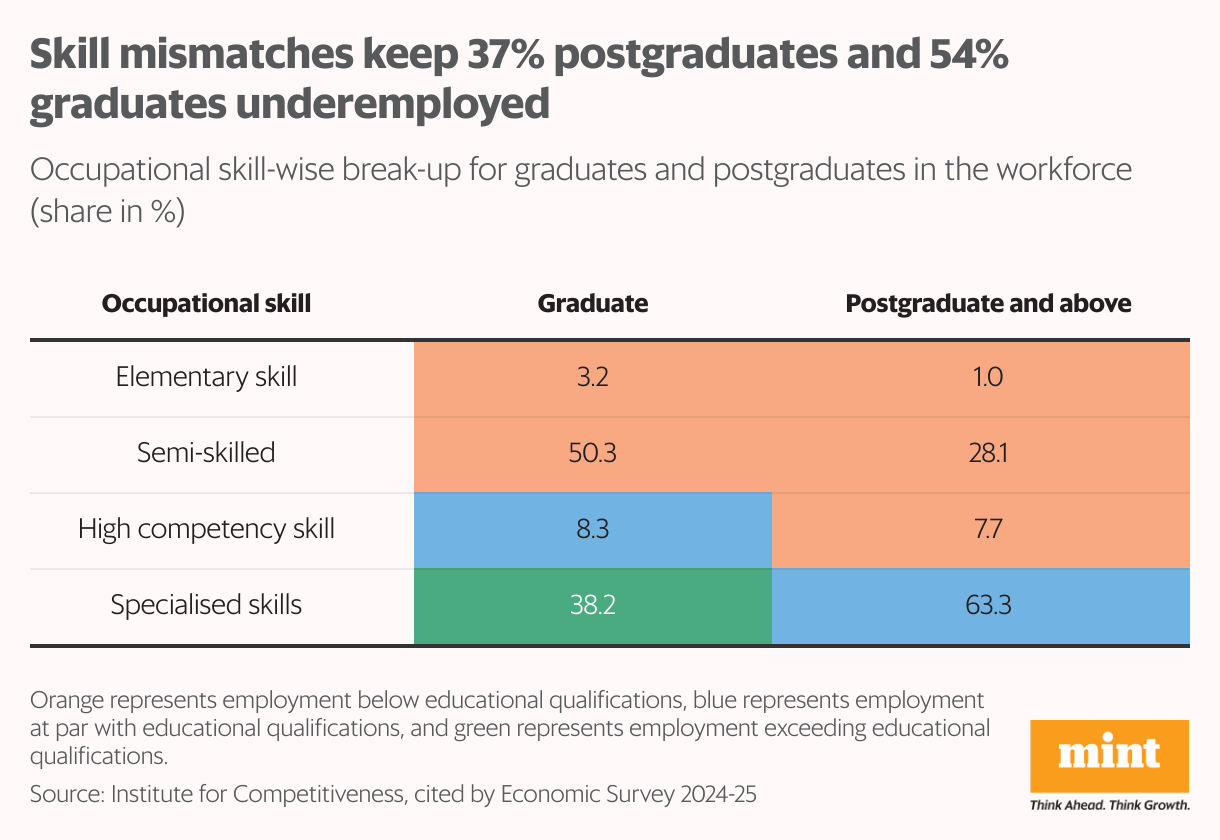
Even after attaining high degrees, the struggles of Indians do not end, as skill mismatches often leave 37% postgraduates and 54% graduates underemployed, meaning their employment is below their educational qualifications, as highlighted by the Economic Survey 2024-25.
According to Lekha Chakraborty, a professor at the National Institute of Public Finance and Policy, there is a need to increase the government’s spending on education to around 6% of GDP from about 3% currently to address the shortfalls in the publicly-funded education and achieve the goal of ‘Viksit Bharat’ by 2047.
Chakraborty also said that the CMS: Education survey can help analyze the widening inequalities in the education system. “Policymakers to design policies to address inequities and ensure that public spending benefits the most disadvantaged groups, ultimately promoting more equitable access to quality education,” she added.