
Flex Circuit PCBs in Consumer Electronics
Smartphones and similar handheld devices are constantly taken into different environments, such as extreme temperatures when people leave them in their cars and intense vibrations during driving. These conditions are ideal for flex circuit PCBs. Flex circuits are also used in medical and pharmaceutical applications to survive the rigours of human use, such as diagnostic monitors, ultrasonic imaging scanners, intravenous devices and more.
In addition to their flexibility, flex circuits help manufacturers reduce an application’s weight and size. Their thinner design makes them more compact, and their conductive copper layers are etched at a much lower rate than those of rigid circuit boards. This allows them to fit in smaller spaces while providing the same level of reliability that customers are used to from traditional circuits.
The conductors on a flex circuit pcb are etched on both sides of the substrate film. This allows designers to create requirement-specific trace patterns on both sides of the board, and connect these using copper-plated through holes. This allows a flex circuit to deliver high current, meet impedance specifications and handle higher power levels than rigid circuits.
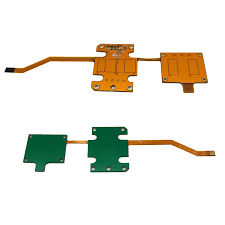
Applications of Flex Circuit PCBs in Consumer Electronics
These flexible circuits are designed to accommodate a variety of connectors and components. They can be manufactured as double-sided, single-sided or multi-layered. The conductive material traces can be made of copper or a wide range of other materials, depending on the application. A coverlay is then applied to protect the traces from moisture and contaminants. The thickness of the traces is determined by the design, and the copper can be plated with either panel plating or button plating. Panel plating provides a more even distribution of copper, while button plating limits the amount of copper to pads on each pad.
Flex PCBs are known for their excellent electrical and thermal performance. They have a higher surface-to-volume ratio than rigid circuits, and their thinner design makes it easier for heat to disperse. They can also be designed with fewer point-to-point connections, which increases the reliability of an entire system.
When constructing a flex circuit, it’s essential to consider the substrate, coverlay and adhesive materials. A flex circuit should have insulators to separate the conductors and prevent them from conducting current on each other. Insulators typically consist of polyester, solder mask or polyethylene naphthalene. They can be bonded to the substrate using epoxy, acrylic or pressure-sensitive adhesives.
Stiffeners are added to some flex circuits, and they can be made from a variety of materials including aluminum or stainless steel. They are often used to increase the strength of a flex circuit or add rigidity where it is expected to bend. They can also boost abrasion resistance and strengthen solder junctions.
The best flex circuits are a result of careful design and construction. This is why it’s important to work with an experienced supplier. They can guide you through the process and help you develop a solution that will meet your requirements. PCBway has a flex circuit calculator that can be used to determine the best flex circuit for your application.