
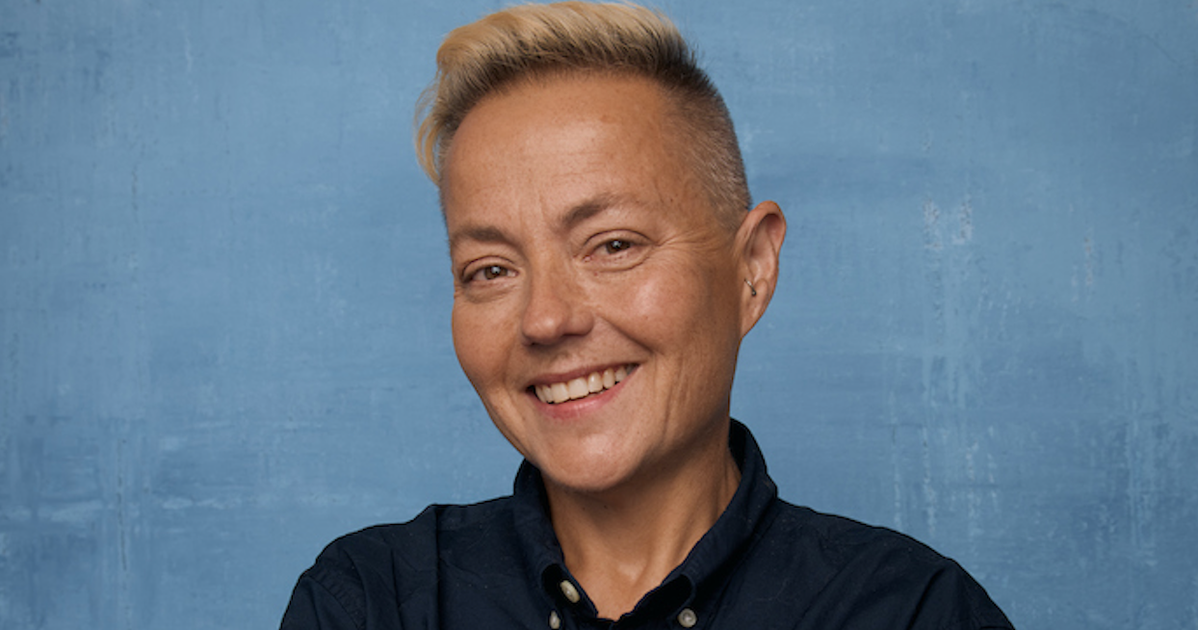
I’ve lived many lives. This includes an enthusiastic (and very earnest) half-dozen years of my adolescence and young adulthood as an energetic Daytona Beach, Florida-dwelling born-again Christian. I participated in activities such as going to church four times a week, asking strangers on the bus if they had accepted Jesus Christ as their personal savior, and giving out Gospel tracts on the beach.
These days I’m an enthusiastic (and truthfully, equally earnest) nonbinary large-city-dwelling queer. My activities now include things like making triple-threat art as a comedian/writer/nurse, chatting with patrons at my neighborhood coffee shop about ethical nonmonogamy, and attending protests, some of which also happen on the beach.
So when I receive a social media friend request, the potential connection could come from Column A or Column B, and one Column B friend describes me as having an “accept ’em all, let God sort ’em out” strategy.
Some of my Column B friends don’t love my social media friend anarchy, especially when interactions about a presumably neutral topic go deeply and bizarrely awry.
“Um, why am I arguing with some guy you went to high school with about how 5G and scripture prove the Earth is flat on your post about finding a home for a three-legged kitten?” my friend will text on a random Tuesday afternoon.
These interactions can be surprising and deeply troubling, it’s true. But mostly, my friends don’t love my All Friends Aboard policy because they love and worry about me.
The ongoing painful struggle of a queer adult who came out of a rejecting, evangelical Christian past is, unfortunately, a common experience. But it’s not my experience. I was not out as queer or genderqueer in high school. Perhaps I should have been. I did love softball, and I owned a mirror.
Photo Courtesy of Kelli Dunham
I even knew a few LGBTQ+ folks personally, but they were mostly deeply stuck in chaotic, often messy closets. I don’t think I fully understood exploring my sexual orientation or gender identity as a constructive potential option for me.
During this time, the people of my church’s youth group showed me great love, transformative love even. My involvement in the youth group kept me busy and out of trouble. Especially the kind of trouble that an extremely under-supervised child of an exhausted single mom might find in Daytona Beach, Florida, in the 1980s. So maybe I connect in gratitude.
I’m not so full of myself that I think my hilarious recounting of encountering bodily fluids on the A train, hot takes on the “Real Housewives” in Montana, and yearly repost of my grandmother’s chocolate sheet cake recipe are so inherently valuable that they provide some kind of karmic repayment for the impact this had on my youthful self. Instead, my positive memories of positive interactions make me shrug a little and think, “Why would I let a little thing like being on the opposite sides of the culture war break up a cyber friendship? How bad can it be?”
Sometimes it’s not bad. Sometimes it’s hilarious.
For example, the convention of evangelicals using their Facebook status for direct address prayers keeps me guessing as I scroll. At a quick glance, “Thank you, Jesus, for keeping my boy Jake safe from the snapping turtle last night” might be literal, or it could be a drag queen friend, ironically subposting about a Grindr encounter.
Sometimes, it’s heartwarming and hopeful. My second cousin, someone I know from eighth grade Sunday school, and an ex-girlfriend wade into difficult conversations, and we have a meaningful exchange. Especially when we’re talking about injustices that aren’t mine to forgive, it can feel, if not impactful, at least not unimportant.
And sometimes it’s June. For the past decade, nearly every June, I have decided, “It’s happening. I’m pruning my social media friends list.”
That’s because perusing certain corners of social media starting June 1, you might conclude that the entirety of all Christianity — thousands of years of history, worship, every stained-glass window, every theological treatise, everything written on the back of a prayer card — all existed only to communicate the essential tenet of: “OMG Jesus said stop being GAY!!!!!” Even though most mainstream Christian denominations no longer teach this. Not even all evangelical churches still do.
I ignore many of these posts; there isn’t anything about a repost from a Christian rapper whose entire act is anti-LGBTQ+ hate speech that says, “I’m very much open to hearing how this might be destructive, especially from those most directly involved.”
But sometimes, I look up at the square container containing the ashes belonging to my deceased lover Cheryl’s deceased cat Lulu atop my bookshelf and decide to wade in with my heart wide open and my fists held high.
For example, Reverend Sincerity was my beloved youth pastor when I was a born-again, pre-queer high school student. He was extraordinarily kind and exceedingly generous to me when he first met me; I was an obnoxious 10th grader clad in three different neon colors and sporting a terrible spiral perm. He didn’t see me just as a difficult teenager (which, to be sure, I was) but as a promising teenager, with a passion and heart for service. Reverend Sincerity encouraged my writing, telling me it was a gift from God.
Nowadays, 11 months out of the year, we both try to connect — almost heroically — on neutral ground. He comments that my sister and I still look so much alike; I reply to photos of his grandkids.
But when my beloved former youth pastor starts posting about LGBTQ+ people, it’s hard to scroll by. Sometimes I’m uncertain why. His posts are pointed (for example, an allegedly anti-LGBTQ+ Bible verse with no additional commentary), but they’re not dismissive or sarcastic. In my heart — perhaps buoyed by my memory of our long-ago interactions that were so significant to me — I understand this as simply misguided rather than hateful.
Maybe that explains the year I decided to weigh in on an anti-LGBTQ+ post by describing what happened when my partner Cheryl got sick.
Cheryl — an introverted performance poet from Staten Island, a generous sarcastic soul who always had a kind word for a fellow artist — and I had been together two years when she called me from her primary care provider’s office. She’d been having shortness of breath that seemed too severe to be merely her normal allergies. A chest X-ray revealed a grapefruit-sized tumor in her chest. She had Hodgkin lymphoma.
She started treatment, and our friends rallied around us. When Cheryl started to lose her hair, a friend suggested “a good ol’ fashioned lesbian head-shaving ceremony.” We were all so hopeful. Then she developed a severe pulmonary reaction to one of the chemo agents.
The chemo that was supposed to be saving her life was instead killing her.

Photo Courtesy of Kelli Dunham
Cheryl was admitted to Beth Israel, and I slept on a radiator next to her bed in the hospital so she would never be alone for three months before she died.
I explained this all in a comment on Reverend Sincerity’s post, then added:
“Because of anti-gay laws, including laws that banned gay marriage at the time … her mother was able to swoop in after she died. She took Cheryl’s body, and I never got so much as a tablespoon of her ashes. Cheryl’s cat Lulu did come to live with me, which my nephew has informed me ‘is the most lesbian inheritance ever.’ When Lulu passed away, I put her ashes on my bookshelf so I can pretend they’re Cheryl’s ashes. Can you imagine if that happened to your spouse’s body? How devastated would you feel? I get that you can’t change your beliefs…I just want you to know what it costs people like me.”
The response to this? Nothing. Not a single person replied.
I understand on the scale of horrible things, with 1 being a paper cut and genocide being 10, having to pretend your dead lover’s cat’s ashes are your dead lover’s ashes is a 1.7.
But it seemed … relatable. Until I mentioned this exchange (or lack thereof) to a friend who frowned so hard at me I thought her forehead might break.
“Um, what do you think the word relatable means?” she asked, apparently rhetorically, because she immediately continued. “Those folks couldn’t imagine that happening because their relationships would never be in that kind of danger. It’s the very opposite of relatable to them.”
My friend wasn’t very subtle, but she also wasn’t wrong.
“Why are you arguing with someone you haven’t seen in three decades?” my same friend asked later. “You don’t get it. He really believes what he’s posting.”

Photo Courtesy of Kelli Dunham
I know he really believes it.
He really believes that the love that Cheryl and I had for each other would send us both to a literal hell, an eternal fiery torment which, by pretty much any account, is worse than grieving your lover’s death with her cat’s ashes.
I spent high school observing the power that midsize cities afford their most successful pastors, and because of this, I also know Reverend Sincerity is an influencer in the truest sense of the word. Meaning “one who influences” rather than “a person an online therapy platform pays to make videos about drama in the fiber arts community.”
I also know it would be almost statistically impossible for him not to have a closeted young queer kid in his congregation who is reading every anti-LGBTQ+ word he writes. It’s unlikely I’m changing anyone’s opinion, certainly not Reverend Sincerity’s. But I’m reminding him (and everyone else engaging with the post) that there is another opinion to be had.
Perhaps more importantly, I’m giving a face and a history to what might otherwise seem like an abstract issue.
So as another June passes in which I’ve decided not to block, unlike, unfriend or unfollow after all, I think what I’m asking of my old friends is this: “Believe what you want, but look me in the eyes when you say it.”
Do you have a compelling personal story you’d like to see published on HuffPost? Find out what we’re looking for here and send us a pitch at [email protected].