
Last Updated:
The monsoon may still arrive each year but it’s no longer arriving the same way. And that changes everything.
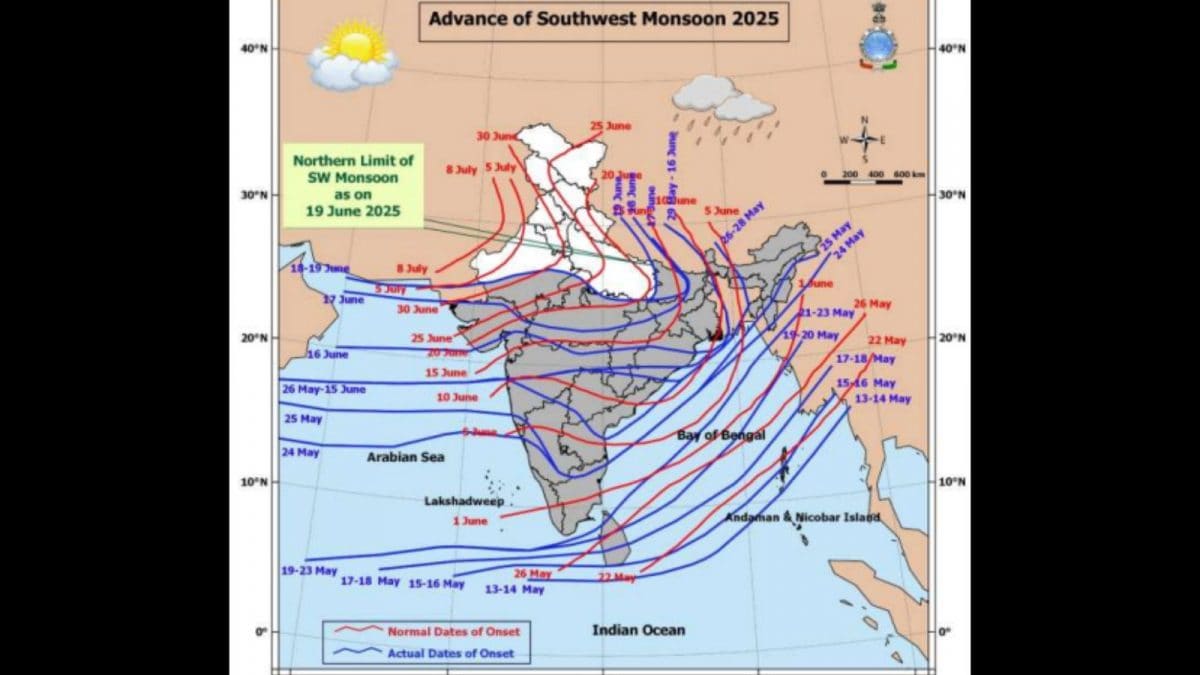
Typically, monsoon blankets the entire country by July 8, but this year, it has been running ahead of its normal schedule. (News18)
India’s lifeline, the monsoon is becoming increasingly erratic. Traditionally viewed as a seasonal constant, the southwest monsoon is now showing clear signs of variability in onset, distribution, and withdrawal, with profound implications for agriculture, water security, and climate planning.
As Vishwas Chitale, Senior Programme Lead, Council on Energy, Environment and Water (CEEW), notes, “CEEW research shows that India’s monsoon is becoming more variable not just in its onset and duration but also in how rainfall is distributed across regions and months.”
Recent data underscores this shift. Over the last decade, 55% of India’s tehsils experienced over a 10% increase in southwest monsoon rainfall. Conversely, 11% of tehsils saw a decline, especially in critical agricultural zones like the Indo-Gangetic plains, northeastern states, and the Himalayan belt. Alarmingly, 87% of these declines occurred in June and July—the crucial sowing window for kharif crops like paddy, maize, and pulses.
Compounding this, 64% of Indian tehsils have reported more heavy rainfall days, and nearly half have seen a 10% or more increase in October rainfall, indicating a delayed monsoon withdrawal. These changes not only disrupt sowing and harvesting cycles but also put added stress on water management, flood control systems, and rural livelihoods.
Chitale warns that reactive adaptation will not be enough. “We need localised climate risk assessments, updated crop calendars, and resilient water and infrastructure systems that can respond to both increases and reductions in rainfall,” he says. “Investing in early warning systems and climate-intelligent infrastructure is no longer optional but essential.”
Echoing this urgency, Harsh Vardhan Bhagchandka, President IPL Biologicals, emphasizes the need to rethink how we farm, “The evolving monsoon patterns across India are not just a shift in weather—they are a signal that our agricultural systems and climate resilience strategies must adapt rapidly. At IPL Biologicals, we believe the future of food security depends on integrating biological innovations as a climate-smart practice that helps overcome stresses better for future food security.
By deploying microbial-based products and bio-stimulants tailored to enhance root growth and nutrient uptake, we are empowering farmers to maintain yield quality even under erratic rainfall. These biological solutions work in harmony with soil ecosystems, improving air circulation, water retention, and reducing dependency on chemical inputs.
We are also collaborating with agricultural bodies to develop predictive cropping calendars, using real-time weather data to optimize planting schedules and integrate biologicals into the farmer’s package of practices (POP). What we are seeing now is more than climatic disruption—it’s a clarion call for crop resilience. Biological innovation is not a luxury, it’s an imperative.”
India’s agricultural strategy must now pivot toward resilience and precision planning, ensuring farmers are not blindsided by unpredictable rains. With climate change intensifying, the monsoon’s mood swings are no longer anomalies—they’re the new norm.
The monsoon may still arrive each year, but it’s no longer arriving the same way. And that changes everything.

Swati Chaturvedi, a seasoned media and journalism aficionado with over 10 years of expertise, is not just a storyteller; she’s a weaver of wit and wisdom in the digital landscape. As a key figure in News18 Engl…Read More
Swati Chaturvedi, a seasoned media and journalism aficionado with over 10 years of expertise, is not just a storyteller; she’s a weaver of wit and wisdom in the digital landscape. As a key figure in News18 Engl… Read More
- First Published: