
Note: This essay discusses non-suicidal self-injury.
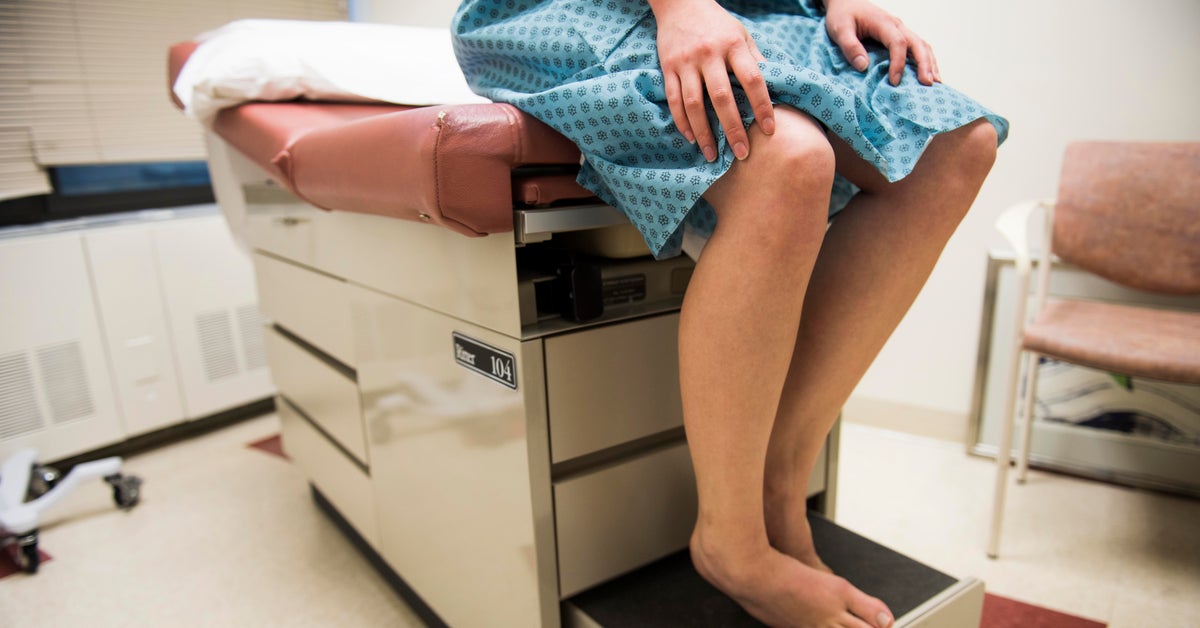
On a dreary Friday morning I sat in a sterile beige room wearing a paper gown while a doctor I hadn’t seen before performed my annual physical. As she tested my reflexes at my wrist, her eyes landed on an injury I’d given myself days earlier. Paper gowns leave few places to hide.
The doctor launched into a slew of questions before instructing me to stand so she could examine the rest of my body for any other marks made by my own hand. I assured her there was nothing else to find, but she wasn’t convinced. While I stared at the eye chart on the wall opposite me and tried to occupy my brain by memorizing the letter sequence, she scoured every inch of my skin looking for fresh wounds. She found nothing, just like I’d promised.
She was doing her job in the best way she knew — I can’t fault her for that — but in the time between when we laughed together about the loud doctor in the next room and when I stood mostly naked under her gaze, I became a problem, not a person.
As part of the 5% of adults who report a history of self-injury at some point in their life, I’m no stranger to uncomfortable interactions with medical professionals. When I fell into self-injury at 15, it served as a way to control the world around me — to keep my personal pendulum from swinging into feeling too much or too little. It helped me stay centered, grounded — until it didn’t.
I didn’t anticipate the impulsive decision I made at 15 to become a habit I carried into adulthood. I didn’t know there would be a cost. (Everything comes at a cost.)
For over a decade, my body has been the piece of myself I’ve always needed to explain away, to justify, to apologize for. Misinformation and pervasive stereotypes incorrectly assign motives to my habit. I’m often forced to choose between playing self-advocacy, which others assess as argumentative and uncooperative, and staying silent, allowing incorrect and harmful assumptions to be made. Neither option feels right.
As much as I try to anticipate the questions I will be asked and rehearse the answers I’ll give, it is never far from my mind: The burden of proof is on me. It is up to me to convince professionals in a position of authority to believe the words I am saying, to believe the sanity I claim, and to believe that I am still deserving of kindness and compassion. But it shouldn’t have to be.
As a society, we expect medical professionals to be just that: professional in the face of injury and illness. We expect doctors and nurses to see us at our most vulnerable, at our most human, and treat us with the dignity our humanity deserves. Unfortunately, self-injury scars often become an invitation for mistreatment. While my history of self-injury is no one’s fault but my own, the response to such a discovery needs to change.
Although additional training would be nice, I don’t expect medical professionals to be experts on the nuances of non-suicidal self-injury. I’m not offended or surprised when I see discomfort etched in the faces of doctors suddenly presented with a situation they didn’t anticipate. NSSI is a highly stigmatized and often overlooked portion of the psychological landscape, even in a world increasingly more open to conversations about mental health.
What I do expect during routine medical visits in which my history is revealed is a level of patient care that dignifies the complexities of my existence. Rather than leading with disgust or contempt, medical professionals should respond with curious compassion and patient-forward language, just as they would if a patient presented with any other issue. Anything less is unacceptable.
There is no place in the medical world for practitioners to cause more pain — physically, verbally or psychologically — simply because someone has already intentionally injured themselves. NSSI, however unhealthy, serves a function. Antagonistic medical care does not.
Satisfied with her search that day, the doctor pressed on my wound, watching its color blanch and return over and over again. In spite of the pain, I willed myself not to flinch. I willed myself to become invisible.
It wasn’t the first time I’ve been boiled down to a bad habit, and it probably won’t be the last, but it never becomes less dehumanizing to have your body searched and examined as if you aren’t inhabiting it.
I’ve always had a complicated relationship with the scars that came from my own hand. I spent years trying to hide them and disguise them, covering them with bracelets and long sleeves and waterproof makeup. I hated that someone could look at them, look at me, and be left with the impression they knew my story. I did everything in my power to make sure that didn’t happen.
Really, though, whether we’re the patient or practitioner, whether we wear our pain on our heart or our wrist, we’re all the same — made of stories and scars, and strength and struggle. We all want to be seen and known and loved for who we really are. We all want to be met in our hardest moments with understanding and grace. We all want to know that our worth is not determined by our actions or our experiences, and that our value is not defined by some arbitrary scale of goodness or deservedness.
With her mouth flattened into a thin line and her eyebrows knit together, the doctor straightened. “Don’t hurt yourself again,” she said. Her disgust was palpable and left a pit in my stomach. “That’s all.”
She let the door slam behind her as she left. With a shaky breath, I slipped the paper gown off my shoulders and let it fall to the floor. The shame that had settled over me remained.
In my imaginary, best case scenario, she would have let me dress before sitting down across from me, looking me in the eye, and asking some questions that left air in the room for us both.
She could have asked, “Can you share what purpose self-injury serves for you?” (The answer changes.)
She could have asked, “Are you seeing someone about this?” (Yes, a therapist I love to hate because she helps me do the painful work of peeling away the layers of life that led me to self-injury in the first place.)
She could have asked, “Has that helped? (Yes, most of the time anyway.)
She could have asked, “Would you like help finding additional resources?” (No, not right now.)
She could have said, “Let’s touch base about this at your next appointment and make sure nothing has changed.”
Instead, I left the office doubting I’d return.
When I got home I put on as many layers as I could in an attempt to separate myself from the body that had just been picked apart, from the body that bears evidence of years of desperate decisions. My instinct is to isolate and insulate, to bury my humanity deeply enough I can pretend it doesn’t exist, to become so disconnected from myself that my body doesn’t feel like my own began to fall into place.
And then I remembered: This body, with all her scars and stretch marks and imperfections, is good.
Brittany Tinsley is a writer and speaker living in Dallas. When she isn’t writing, she can be found working her way through all the national parks with her husband and daughters. You can find more of her work at brittanytinsley.substack.com, or connect with her on Instagram @brittanytinsleywrites.
Need help with substance use disorder or mental health issues? In the U.S., call 800-662-HELP (4357) for the SAMHSA National Helpline.
Do you have a compelling personal story you’d like to see published on HuffPost? Find out what we’re looking for here and send us a pitch.