
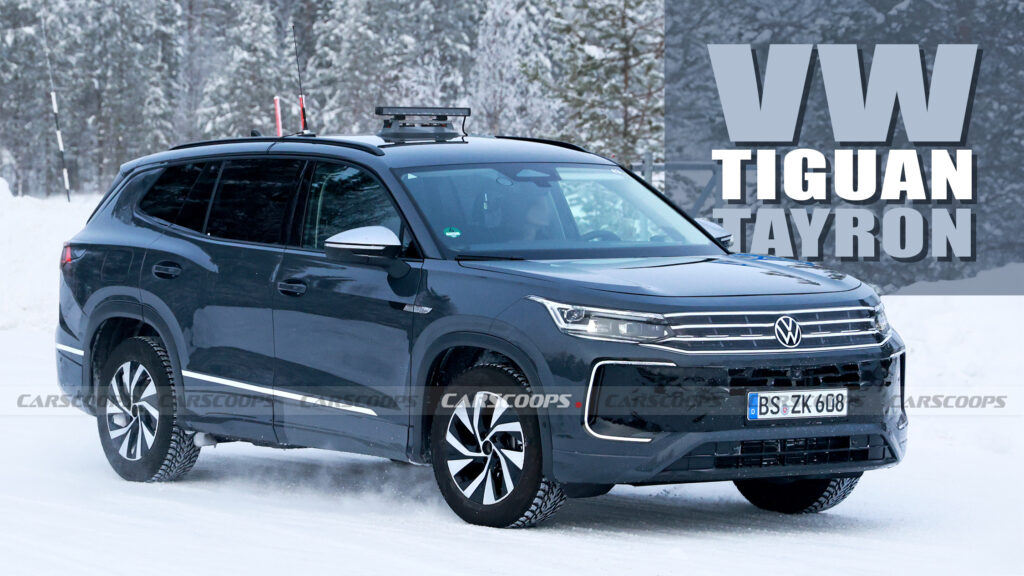
Volkswagen’s attempts to balance the needs of its domestic market against those of the giants to the East and West have led to a global lineup that’s akin to one of those holographic images that change depending on your viewpoint. Case in point: the next-generation Tiguan for North America, which is also the second-generation Tayron, depending on where you live.
window.ramp.que.push(function () {
window.ramp.addTag(“pwMobiMedRectAtf”);
})
Caught for the first time by our intrepid spy photographers, the upcoming model is a seven-seat compact crossover that’s longer than the current European-market Tiguan revealed last year and shorter than the Atlas. VW will will no longer call it the Tiguan Allspace in Europe. Instead, it will borrow a name first used in China to distinguish it from the shorter five-seat vehicle: Tayron.
And if that’s not complicated enough for you, consider that in addition to the new Tayron pictured here, VW will also introduce a long-wheelbase, three-row version of the new European market Tiguan in China under the Tiguan L nameplate, as previously disclosed by the Ministry of Industry and Information Technology. VW’s strategy with the SUV mirrors its approach to offering the Passat and the Magotan, two similarly-sized sedans, as well as the ID.7 and ID.7 S electric sedans, from different joint ventures in China.
advertisement scroll to continue
window.ramp.que.push(function () {
window.ramp.addTag(‘pwDeskMedRectAtf’);
})
window.ramp.que.push(function () {
window.ramp.addTag(“pwMobiMedRectBtf1”);
})
Read: VW Confirms U.S. 2025 Tiguan Allspace Will Be Based On Chinese Tayron SUV
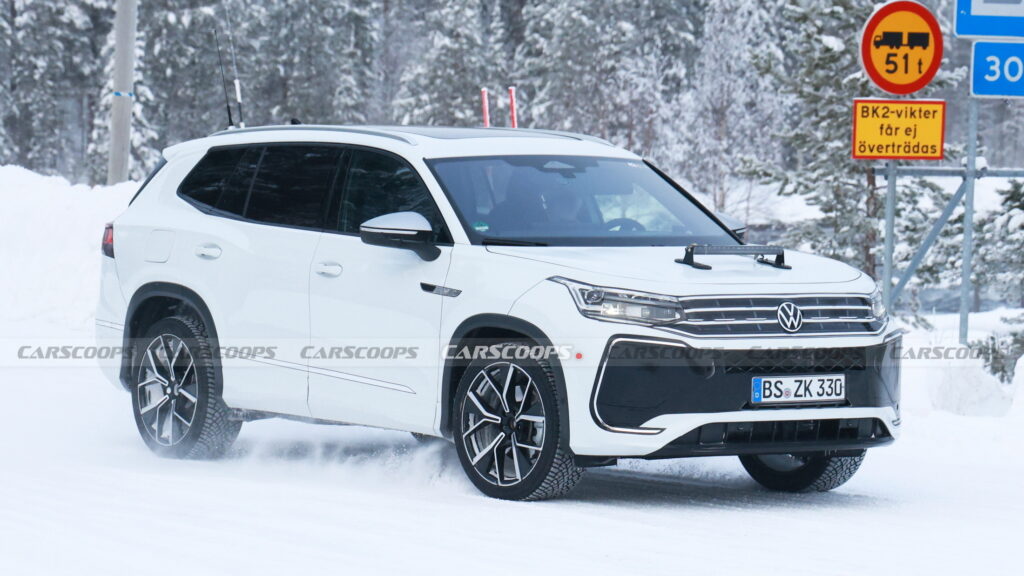
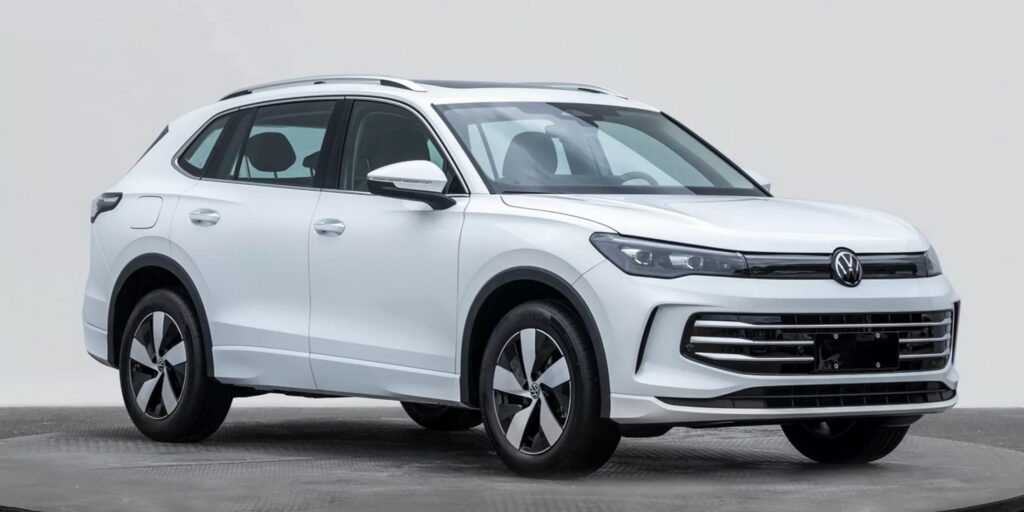
To distinguish China’s new Tayron and North America’s 2025 Tiguan from the also new Tiguan L, VW opted for a slightly boxier design for the former. Although some areas of the Tayron still feature camouflage in these photos, the third glass panel along the side of the vehicle appears to be longer than the Tiguan L’s, as does the rear three-quarter panel. We anticipate that additional differentiating details will emerge once the grille and tailgate are revealed.
To complicate the matter, VW confirmed that the vehicle we’ve been referring to as the Tayron up until now will also be sold in the U.S. (and we can presume Canada), except in that market, it will be called the Tiguan to capitalize on the brand recognition.
window._taboola = window._taboola || [];
_taboola.push({
mode: ‘thumbnails-a-mid’,
container: ‘taboola-mid-article’,
placement: ‘Mid Article’,
target_type: ‘mix’
});
window._taboola = window._taboola || [];
_taboola.push({
mode: ‘thumbnails-oc-2×1’,
container: ‘taboola-mid-article-thumbnails-organic’,
placement: ‘Mid Article Thumbnails Organic’,
target_type: ‘mix’
});
America’s taste for longer vehicles means that the shorter Tiguan hasn’t been sold here since a longer version has been available. However, instead of receiving the Chinese Tiguan L, we will get the rebadged Tayron, which is being designed as a global vehicle.
So far, we know that the Tayron/Tiguan will be based on the MQB evo platform, but some questions remain. We would anticipate that European buyers will be offered a similar lineup of powertrains as the smaller Tiguan (which includes two PHEVs a diesel, and two 1.5-liter gas engines), but that has not yet been confirmed. Whether Americans will also get the plug-in hybrid variants remains to be seen, but given their recent popularity, it would seem sensible to offer them.
Unfortunately, it’s not yet clear when VW will unveil the new Tayron/Tiguan, but we expect it to go on sale for the 2025 model year.